Dots Commander: RTS War
- 3.8
- Rating
- 50.00K
- Installs
- Free
- Price

 Analysis by App-foxy
I went into Dots Commander: RTS War expecting a compact strategy game, and that is exactly where it works best. It puts me in the role of directing dots through a war-focused map, taking cities and growing an army rather than asking me to manage a huge, complicated empire. The appeal is immediate: make a move, watch the battlefield react, decide whether to press forward or rethink the next attack, then start another attempt with a better idea.
That simple loop makes the game easy to understand, but it also creates a clear limit. This is not the kind of strategy title I would choose when I want a long campaign full of diplomacy, detailed economies, or a deep technology tree. It is better suited to short bursts of tactical thinking, especially when I want something more active than a puzzle but less demanding than a full-scale real-time strategy game.
How the battlefield turns one move into another
I use this section to look at how a single command can reshape the choices that follow, rather than treating each city as an isolated target. Paying attention to those connections helps me spot when a promising advance could leave the rest of the position exposed. From there, it makes sense to consider the small checks that help a session start smoothly.
You May Also Like

 Pandora - Music & Podcasts
Pandora’s Music Is Easy to Start, but Harder to Recover
Pandora’s strength is its low-effort path from a seed to a station. Its weak spot is how much confidence it asks you to place in connection, setup, and quiet recovery.

 8 Ball Pool
 Is Built on Rivalries, Rematches, and Routine
A close look at the rivalries, rematches, shared routines, and unanswered safety questions that turn a quick pool match into a persistent mobile community.

 Samsung Music
’s Quiet Strength Is Playing What You Already Own
Its reach comes less from spectacle than from dependable access to a personal library. That simplicity is both the app’s strongest retention engine and its ceiling.

 AccuWeather: Weather Radar
AccuWeather Review: A Quick, Clear Forecast for Everyday Decisions
For everyday plans, the best forecast is the one you can understand quickly. AccuWeather makes rain timing, radar, and local conditions easy to act on, with a few trade-offs.

 Hill Climb Racing
Why Hill Climb Racing Still Turns Crashes Into One More Run
A tiny car, a bumpy hill and one more upgrade: Hill Climb Racing keeps resurfacing because its simple chaos makes every near-miss feel personal.

 AliExpress - Shopping App
AliExpress Makes Global Shopping Feel Personal, but Shoppers Bear the Risk
AliExpress turns a global marketplace into a pocket-sized discovery engine. Its reach is useful, its shopping loop compelling, and its trade-offs easy to miss.
More From Our News Desk
View All News


The first command is easy to understand
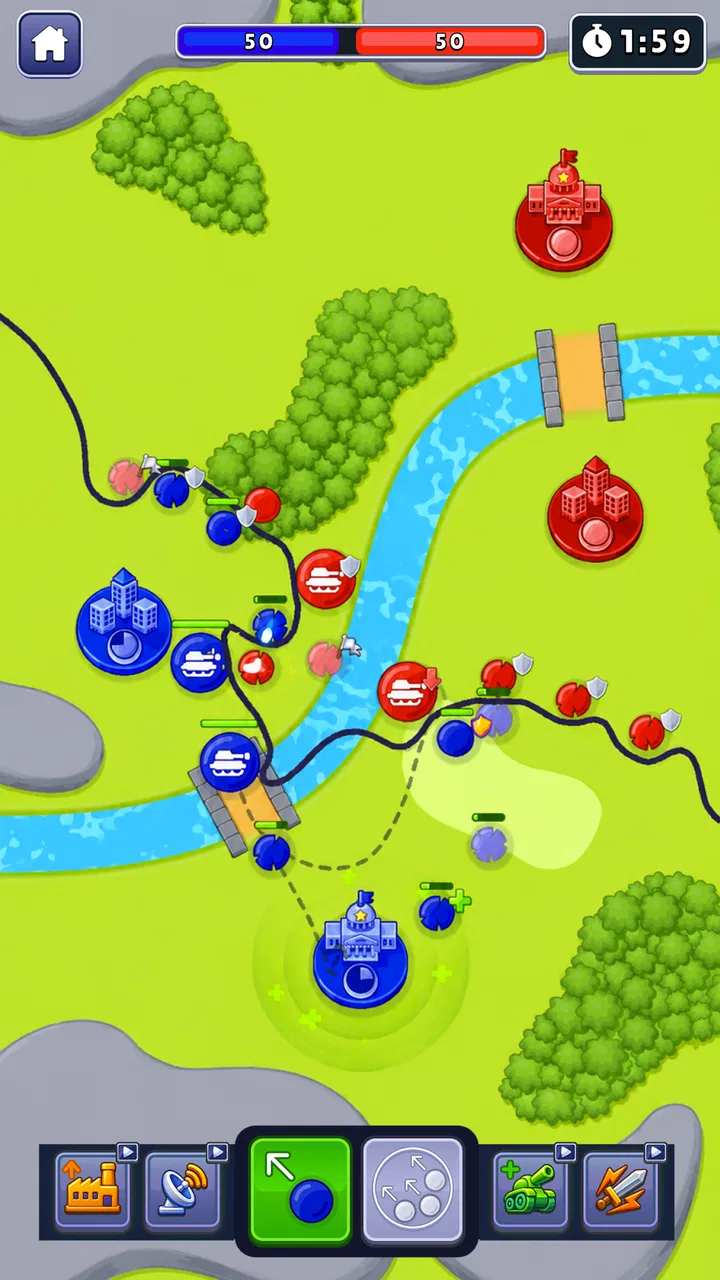
The opening action is straightforward: I command dots in a battle for control of cities. That gives the game a useful sense of purpose from the beginning. Instead of spending a long time learning a fictional world or reading through layers of menus, I can focus on the central question: where should my force go next, and is that move likely to help me take more territory?
The dot-based presentation keeps the battlefield readable. It does not try to make every unit look realistic, and that is an advantage here. I can concentrate on movement, pressure, and territory rather than visual clutter. For a player who enjoys seeing a plan develop from a small starting position into a larger army, the format has a satisfying clarity.
My preferred way to approach a new situation is to resist the temptation to send everything toward the nearest city. A first attack may be possible, but that does not automatically make it the best opening. I look at the available space, consider how exposed the next move might leave me, and try to preserve enough strength to respond when the opponent changes the situation. That small pause is where the strategy begins.
This is also why the game can appeal to people who normally avoid complex war games. The basic objective is understandable without requiring a glossary. You are not asked to memorize a long list of systems before making a meaningful decision. The challenge comes from choosing the order of your actions, not from decoding an intimidating interface.
Movement matters more than simply attacking
The most useful lesson I found is that expansion should be treated as a sequence rather than a collection of isolated victories. Taking one city can open a path toward another, but it can also pull the army away from a safer position. I get better results when I think about the next two decisions at the same time: what does this attack gain, and what does it make vulnerable?
That approach gives the first action more weight than the store summary might suggest. A command is not only an instruction to capture something. It is also a way of shaping the next exchange. Sending dots toward a target can create momentum, but it can also force me into a reaction if the opposing side finds an opening. The game is most enjoyable when I am making those trade-offs instead of clicking through a predictable route.
Players who want an immediately busy battlefield may find the presentation restrained. The focus is on commanding dots and conquering cities, not on a flood of visual effects. I see that as a strength when I want to think clearly, although it means the experience may feel too plain for anyone looking for cinematic combat or elaborate unit animations.
Feedback gives each decision a consequence
The central rhythm is built around action and response. I issue a command, the battlefield changes, and that change tells me whether my idea was sound. A successful push makes the next objective feel reachable. A poor move exposes the weakness in my plan and encourages a different approach on the next attempt. That feedback is more important than decoration because it gives the short sessions their momentum.
I especially like games where the result of a decision is visible enough to teach me something. Here, the useful question after a setback is not simply “Why did I lose?” but “Which decision created the problem?” Was the attack too early? Did I spread the army too thin? Did I focus on a city while ignoring the route around it? Thinking in those terms turns a failed attempt into preparation for the next one.
The feedback loop also makes the game approachable for younger players. The content rating is Everyone, and the abstract dot presentation keeps the war theme from becoming graphic or disturbing. I would still play alongside a child at first, not because the controls seem intimidating, but because strategy games are easier to enjoy when someone explains why a move worked or failed.
The reward is progress through better decisions
The most convincing reward is the feeling of converting a small force into a larger position. Capturing a city is satisfying because it changes the shape of the map and gives the army a clearer direction. The reward is not only the immediate win; it is the sense that the battlefield now offers more possibilities than it did a moment earlier.
That makes the game a good fit for players who enjoy gradual control rather than one dramatic finishing move. I like seeing a plan become more ambitious as the army grows. A cautious opening can lead to a stronger mid-session position, while a reckless rush may produce a quick setback. The game encourages me to improve the route, not merely repeat the same attack faster.
The free entry point helps with that experimentation. I can try the core experience without paying upfront, which makes it easy to decide whether this compact style of strategy suits me. There are in-app purchases ranging from $1.99 to $9.99 per item, so I would approach spending carefully and treat it as optional rather than part of the basic reason to install the game. Anyone who dislikes purchase prompts should check how comfortable they are with that model before committing time.
One practical tip is to avoid judging the game after a single short attempt. The reward becomes clearer when I compare decisions between sessions. If I repeatedly lose after expanding in one direction, I can change the opening route and see whether the result improves. That self-testing process is more valuable than chasing a quick victory without understanding what caused it.
Why another session begins after a reset
A reset is useful when it feels like a fresh strategic question rather than a punishment. After an unsuccessful run, I know more about the way I approached the map, even if I do not carry every advantage forward. I can alter the opening, protect a different route, and test whether a more patient expansion produces a stronger position.
This is the point where the game’s compact design works in its favor. A reset does not feel like abandoning a massive campaign that took hours to build. Instead, it gives me permission to try again with a refined plan. The reason to begin another session is not just that the previous one ended; it is that the next attempt can answer a specific question.
For example, I might begin by securing a safer city rather than chasing the closest objective. In another attempt, I might concentrate the army before expanding. Those changes make the reset meaningful. I am not simply repeating a sequence; I am testing a different balance between speed, safety, and pressure.
That said, players who need persistent progression, a strong narrative, or a large collection of unlockable systems may find the reset loop less compelling. The game’s attraction rests on replaying the command problem, not on building a character over a long story. If your ideal strategy game remembers every campaign achievement and steadily opens new layers, a larger traditional RTS may be a better match.
Where the game fits among strategy alternatives
Compared with a conventional real-time strategy game, this title feels more focused. A typical large RTS may ask me to gather resources, construct buildings, research upgrades, manage several unit types, and defend a base while attacking elsewhere. Dots Commander: RTS War narrows attention toward commanding dots, capturing cities, and building an army. That makes it faster to enter and easier to play in short sessions, but it also leaves less room for economic planning and long-term infrastructure.
It also differs from turn-based strategy games. Turn-based alternatives give me time to inspect every detail and calculate several moves without immediate pressure. Here, the appeal is the feeling of issuing a command and seeing the battlefield respond. I would choose this game when I want decisions to have a quick visible effect, and I would choose a turn-based title when I want to analyze a complicated position at a slower pace.
Against casual puzzle games, the difference is the sense of territory and opposition. A puzzle usually asks me to solve a fixed arrangement. This game makes me think about expansion and resistance, so the same basic action can feel different depending on the position I have created. It is still more approachable than a heavyweight war simulator, but it offers more strategic context than a simple matching or timing game.
The trade-off is depth. The streamlined format makes the first session inviting, yet experienced strategy players may eventually want more layers than the dot-command system provides. That is not a flaw by itself. It simply means the game should be judged as a compact strategy experience, not as a replacement for a full desktop-style command game.
Small habits that improve a session
I found three habits especially useful. First, I avoid committing the entire army to one direction unless the position clearly supports it. Keeping some flexibility makes it easier to respond when the next city is less secure than expected. Second, I treat every captured city as a new starting point for planning, not as permission to attack immediately again. Third, I use a failed session to change one major decision at a time, so I can tell what actually improved the result.
That last habit is easy to overlook. If I change the opening, the attack order, and the army distribution all at once, a better outcome teaches me very little. Changing one element creates a clearer comparison. It turns replay into a simple experiment, which suits a game built around quick feedback.
I also recommend playing when you have enough attention to watch the consequences of a command. Although the sessions can fit into spare time, the game is not at its best when I am distracted and issuing moves without considering the next reaction. A short, focused session is more rewarding than a longer one played on autopilot.
Performance expectations and who should install it
The game supports devices running Android 7.1 or newer, and the current version is 1.0.6. That broad compatibility makes it a reasonable option for players using an older Android phone, provided the device meets that requirement. I would still keep expectations realistic: compatibility does not turn the game into a feature-heavy strategy suite. Its value comes from the focused command loop.
Vira Games Inc. presents a free strategy game with an Everyone age rating, and its audience is fairly easy to identify. I would recommend it to someone who wants a simple war-themed game that can be learned quickly, enjoys replaying a map with different opening choices, and likes seeing an army grow from direct commands. It is also a sensible pick for a player who finds full RTS controls overwhelming but still wants more agency than a basic arcade game provides.
I would skip it if your priority is a story campaign, detailed base construction, diplomacy, deep unit customization, or a large competitive ecosystem. I would also be cautious if you strongly dislike in-app purchases, even though the game is free to start. The purchase range is visible enough to consider before installing, especially for families sharing a device.
The current reception is mixed but respectable, with an average rating of 3.8 from around 1.6 thousand ratings. That matches my overall impression: the central idea is accessible and enjoyable, while the limited scope will decide whether it holds your attention. It has passed the point of being an unknown experiment, with over 50 thousand installs, but I would still approach it as a focused game rather than a polished substitute for the biggest strategy names.
My verdict on the complete action loop
The loop is easy to describe and surprisingly effective: I command dots, watch cities and positions change, gain the satisfaction of expanding an army, lose or finish a session, and return with a new plan. The action is immediate, the feedback is understandable, the reward is control over more territory, and the reset gives me a reason to test a better opening.
The best reason to play is the short distance between an idea and its consequence. I do not need to wait through a long setup to discover whether a command was sensible. That makes each attempt useful, whether I win or learn that my expansion was too aggressive. The game is at its strongest when I treat it as a tactical laboratory rather than a grand war epic.
My final recommendation is positive with a clear condition: install it if you want a free, compact strategy game centered on commanding dots and conquering cities, and if you enjoy improving through repeated attempts. I would look elsewhere for a deeper economy, richer campaign structure, or more elaborate battlefield management. For everyone in between, this is an approachable way to spend a focused session, make a few meaningful decisions, and begin again because the next plan might work better.
With its release on Jun 5, 2026, the game is still a relatively early entry in its current form, so I would judge it mainly by the clarity of its present loop rather than by expectations borrowed from larger RTS titles. As it stands, Dots Commander: RTS War offers a clean strategic premise, enough tension to make a reset worthwhile, and a direct style that makes it easy to recommend to the right kind of player.
FAQs for Dots Commander: RTS War
01What is Dots Commander: RTS War, and how does the gameplay work?
Dots Commander: RTS War is a real-time strategy game focused on commanding units, capturing territory, and defeating opposing forces. Matches generally require you to balance offense and defense, position troops carefully, and react quickly to enemy movements. Its simple visual style makes the battlefield easy to read, while the strategic decisions become more demanding as missions and opponents grow stronger.
02Is Dots Commander: RTS War suitable for beginners?
Yes, the game is reasonably approachable for players who are new to real-time strategy games. The basic controls and objectives are easy to understand, but winning consistently requires practice with unit placement, timing, and resource management. New players should begin with the introductory missions and experiment with different tactics before attempting more difficult battles or competitive challenges.
03Does Dots Commander: RTS War require an internet connection?
The connection requirements may depend on the specific mode and version available on your device. Single-player content may be playable without a constant connection, while online features, updates, advertisements, leaderboards, or multiplayer battles can require internet access. It is best to check the store description and test the game offline before relying on it during travel.
04Is Dots Commander: RTS War free to download, and are there in-app purchases?
Dots Commander: RTS War can generally be downloaded without an upfront payment, although availability and pricing may vary between Android and iOS. Free versions may include advertisements, optional purchases, or upgrade systems that can speed up progress or unlock additional content. Review the store listing and in-game purchase information carefully, especially if children will be using the device.
05What devices can run Dots Commander: RTS War, and is much storage required?
The game is designed for mobile devices running a supported version of Android or iOS, but exact compatibility depends on the release and your device model. It usually does not require the storage space of a large 3D game, although updates and cached files can increase its size over time. Check the official store page for current operating-system requirements before downloading.
Pros
- Simple controls make unit deployment easy to learn.
- Matches offer satisfying tactical decisions without excessive complexity.
- Different unit types encourage varied battlefield strategies.
- Runs smoothly on many modern Android and iOS devices.
- Short battles fit well into quick gaming sessions.
Cons
- Progression can feel repetitive after extended play.
- Some upgrades may require considerable time or resources.
- The interface can feel crowded during larger battles.
- Limited strategic depth may disappoint experienced RTS players.
- Online features may depend heavily on a stable connection.

Dots Commander: RTS War
Gallery